We are a leading glass manufacturer based in China,
Specializing in high-quality glass solutions for industrial and architectural applications.
With years of experience and ISO certification, we provide fast, tailored quotes and responsive support for procurement professionals,engineers, and project managers worldwide.
We are a leading glass manufacturer based in China,
Specializing in high-quality glass solutions for industrial and architectural applications.
With years of experience and ISO certification, we provide fast, tailored quotes and responsive support for procurement professionals,engineers, and project managers worldwide.
Heat Treatment Options for Curved and Coated Glass Units
They talk about “tempered” as if it were the universal answer, then discover—usually late, usually expensively—that curved geometry, coating location, edge quality, roller-wave tolerance, anisotropy, nickel sulfide risk, and IGU assembly sequencing all change the decision, and not by a little. Why do so many specs still read like they were copied from a flat-glass tender in 2016?
Table of Contents
The hard truth: curved and coated glass narrows your margin for error fast
I’ve watched projects treat curved coated units like standard tempered lites with a prettier shape, and that is exactly how distortion complaints, coating damage disputes, and remakes start. Once you add curvature radius, sputter-coated low-E stacks, silk-screen zones, heat absorption, and lamination or IGU build-up, the “just temper it” instinct stops being engineering and starts being gambling.
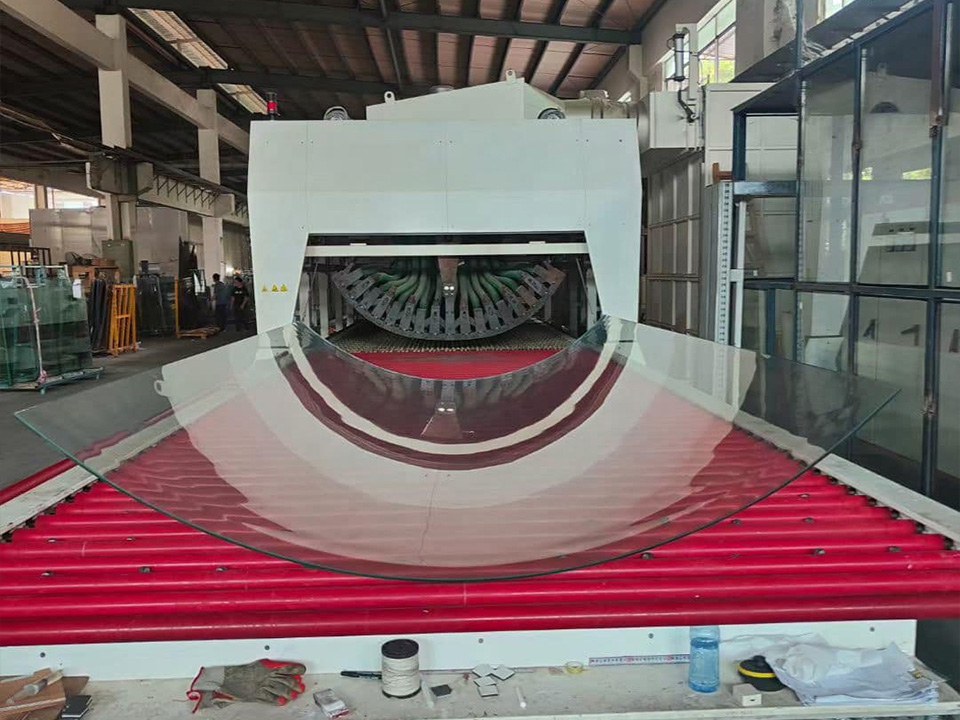
Curved glass heat treatment is not one choice. It is a chain. Furnace recipe, bending method, quench balance, coating compatibility, hole and notch placement, edge compression targets, optical acceptance, and post-processing sequence all matter. Miss one, and the rest of the line pays for it.
That is why I would not separate heat treatment from fabrication planning. A spec team that still treats these as different conversations is already behind. If you need broader fabrication context, your own glass processing for customized projects page is the right internal reference point because the heat-treatment decision is inseparable from the downstream build.
Tempered vs heat-strengthened: the argument people oversimplify
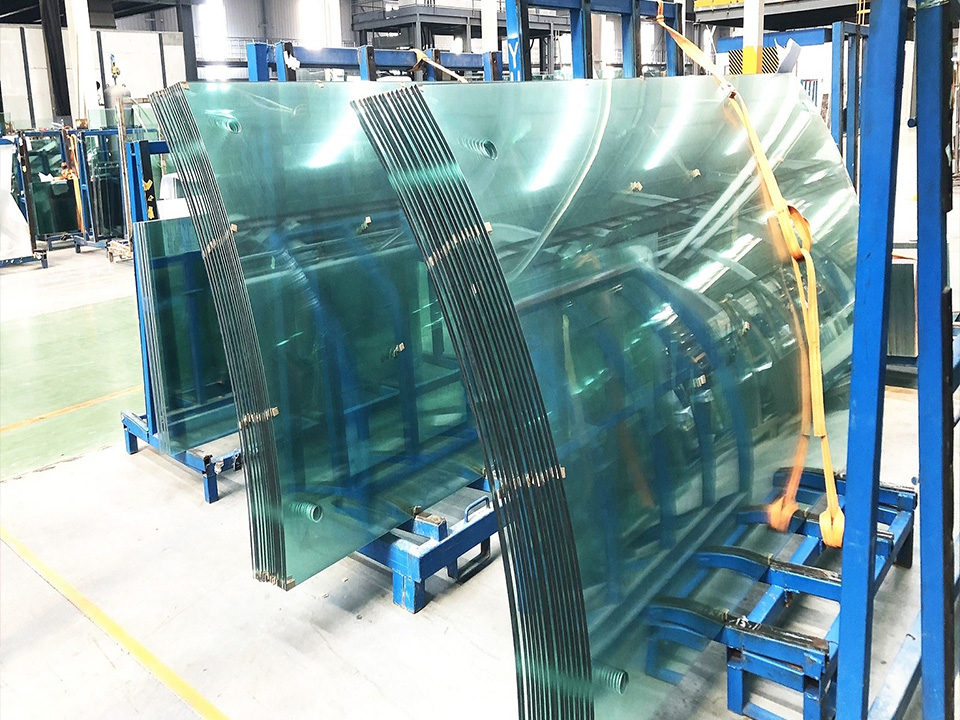
Fully tempered glass gives you higher surface compression and a safety-break pattern that many code-driven applications require. Heat-strengthened glass delivers lower residual stress than fully tempered, better resistance to thermal stress than annealed, and usually a better optical outcome for façades where distortion and reflected-wave complaints can turn into owner-level problems. The catch? Heat-strengthened glass is not a safety glazing substitute where codes specifically require fully tempered or laminated safety assemblies.
And the nickel sulfide issue is not marketing fluff. Guardian notes that fully tempered glass is more prone to spontaneous breakage from certain inclusions than annealed or heat-strengthened glass, and NGA’s technical guidance says the purpose of heat-soak testing is to drive breakage from harmful inclusions during the test rather than after installation.Vitro also states that spontaneous breakage from nickel sulfide stones occurs in tempered glass and recommends heat-strengthened glass whenever heat-treated glass is needed, except where safety-glazing code requirements push the spec elsewhere.
So what do I think? On many architectural elevations, especially where fallout risk can be controlled by laminated makeups, heat-strengthened glass deserves more respect than it gets. Tempered glass is not always the premium answer. Sometimes it is just the noisy one.
For applications where post-temper risk reduction is non-negotiable, your heat-soaked tempered glass for project-spec use link fits naturally because heat soaking is often the second conversation teams forget to have until procurement is already moving.
Coated glass changes the question because the coating is not an innocent bystander
A coated lite is not passive. It reacts to heat history, coating type, placement, and handling discipline.
Soft-coat low-E systems, solar-control stacks, and low-reflectance products can all behave differently in tempering. Some coatings are temperable; some are not; some are technically temperable but punish you with color shift, emissivity drift, edge deletion demands, or stricter furnace control than the sales sheet made obvious. The U.S. Department of Energy says low-E coatings typically add around 10% to 15% to window cost while reducing energy loss by as much as 30% to 50%.That performance upside is real. But it only stays real if the coating survives fabrication, sealing, and field exposure as designed.
Here is the part too many buyers skip: coated glass units should be specified by coating family, temperability, surface placement, and final assembly, not by a vague phrase like “performance glass.” That phrase belongs in brochures, not POs.
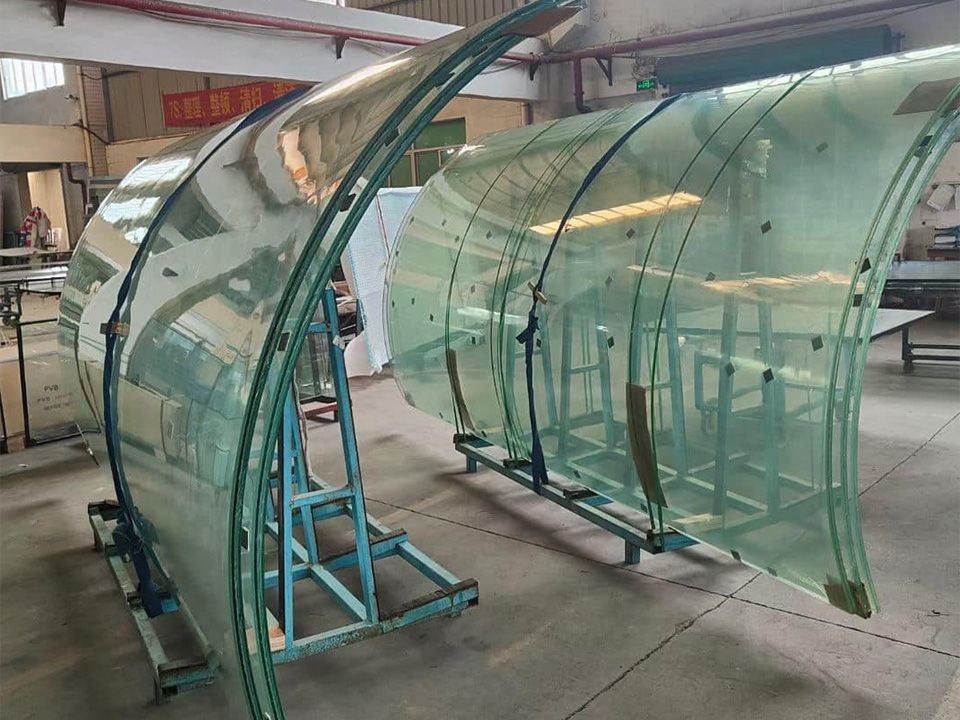
Curved glass is not just bent flat glass; the furnace proves that every day
The moment glass is curved, the acceptable tolerance stack gets tighter while visual scrutiny gets harsher, especially on façades, shower enclosures, canopies, transit applications, and premium retail fronts where reflected lines tell on you from 30 meters away. A radius that looks manageable on a shop drawing can become expensive once you combine thickness, coating, edgework, hole placement, and quench symmetry. Why do some teams still price curved tempered glass as if the bend were decorative, not structural and optical?
That is why I would separate curved units into three practical buckets:
Option
Best use case
Typical strength profile
Optical risk
Coating risk
My blunt take
Heat-strengthened curved glass
Façades, laminated makeups, projects sensitive to distortion
Highest surface compression of the common thermal options
Higher risk of roller-wave/aniso complaints
Higher process sensitivity
Necessary in some specs, overused in others
Heat-soaked tempered curved glass
High-risk façades, overhead or fallout-sensitive applications
Same base class as tempered, with additional screening step
Same optical concerns as tempered
Same coating concerns plus more process control
Good risk-management move, not magic
The 2024 IBC update discussed by STRUCTURE sharpened guidance for glass handrails and guards by specifying maximum stresses for heat-strengthened and fully tempered glass that align with the code’s long-debated safety-factor framework.That matters because it shows the market is moving toward more exact language, not less.
The real specification matrix: what I would decide before signing off
If the unit faces thermal stress from solar absorption, shading patterns, frit bands, shadow lines, HVAC discharge, or dark coatings, heat treatment for glass moves from “nice to have” to required engineering hygiene. If the unit is curved, I then ask whether optical quality or safety-break behavior matters more. If the unit is coated, I ask whether the coating is certified temperable, what surface it will occupy in the final IGU, and whether edge deletion, spacer chemistry, and seal compatibility are already settled. And if the lite will be laminated after heat treatment, I want interlayer and distortion expectations documented early, not after mock-up.
That sequence is not glamorous. It is how you avoid remakes.
Here’s the stripped-down decision logic I would use:
Project condition
Preferred route
Why
Curved façade glass with high visual sensitivity
Heat-strengthened, often laminated
Better optical control than fully tempered in many cases
Curved safety glazing at doors or impact-prone areas
Fully tempered or laminated tempered
Break pattern and code path usually drive the decision
Coated low-E IGU where energy performance is central
Temperable coated glass with validated furnace recipe
Coating survivability and IGU performance must be preserved
High-rise exterior with concern about spontaneous breakage
Tempered plus heat soak, or laminated strategy review
Reduces field-breakage risk from inclusions; does not eliminate all risk
Deep tint, frit, shadow-line, or high absorption condition
Heat-treated lite strongly favored
Thermal stress risk rises fast with uneven heating
And yes, hardware sourcing still matters—but as a secondary procurement issue, not the lead story. Spacers, sealants, gaskets, setting blocks, and framing details can destroy a perfectly made lite if the system pinches the edge or creates point loading. I’ve seen “glass failures” that were really hardware failures with better PR.
Where most coated IGU programs fail: sequencing, not material science
This part annoys me.
Teams obsess over the coating brand and forget the workflow: cut, edge, wash, heat treat, inspect, laminate if needed, assemble IGU, gas fill, seal, test, ship. Any one of those can damage a coated lite or amplify distortion, especially when the unit is curved and oversized. DOE guidance keeps emphasizing that low-E and gas-filled assemblies are chosen to manage heat loss or heat gain based on climate and NFRC-rated performance, which is exactly why fabrication sloppiness is so expensive: you are not just ruining appearance, you are eroding the thermal promise sold to the client.
My position is simple: coated IGU programs should never be sold as commodity output. Once curvature, coating, and heat treatment enter the same sentence, you are in process-control territory.
What buyers should ask suppliers before approving production
Ask whether the coating is fully temperable and on which surface it is intended in the final unit. Ask for radius limits by thickness. Ask whether the supplier has furnace recipes validated for that exact coating family. Ask for anisotropy expectations in writing. Ask whether heat soak is available to EN-style practice or equivalent batch protocol. Ask what edge condition is mandatory before heat treatment. Ask whether mock-up optics are reviewed in transmitted and reflected light. Ask how they manage IGU seal compatibility after coated-glass edge deletion.
Not “we’ve done similar work.” I hate that phrase. Ask for case evidence, mock-up records, distortion criteria, and prior façade examples. Your internal case studies page is the obvious supporting link here because skeptical buyers want proof, not adjectives.
FAQs
What is the best heat treatment for curved and coated glass units?
The best heat treatment for curved and coated glass units is the one that matches the glass geometry, coating temperability, code requirements, optical tolerance, and final assembly method, which usually means choosing between heat-strengthened, fully tempered, or heat-soaked tempered glass after validating the coating stack, radius, thickness, and IGU or lamination sequence.
In practice, I would not call one option “best” across the board. For visually demanding façades, heat-strengthened can be the smarter move. For code-driven safety glazing, tempered often wins. For high-rise exterior risk control, heat soak enters the conversation. The right answer is conditional, not generic.
How do you heat treat curved glass without damaging the coating?
Heat treating curved glass without damaging the coating means using a temperable coated substrate, a validated furnace and bending recipe, proper edge preparation, controlled washing and handling, and a documented inspection standard for color shift, haze, distortion, and coating integrity before the lite is laminated or sealed into an IGU.
This is not just about temperature. It is about process discipline. Wrong roller setup, dirty wash water, poor edge deletion, or casual racking can ruin a coated lite before the quench even finishes. That is why “coated curved glass” should always trigger supplier qualification questions.
Is heat-soaked tempered glass worth the extra cost for façade projects?
Heat-soaked tempered glass is an additional post-temper screening process designed to force breakage from some harmful inclusions, especially nickel sulfide-related risks, during factory testing rather than after installation, making it a risk-reduction measure that is often justified for high-rise façades, overhead glazing, and fallout-sensitive applications.
Worth it? Often, yes. But I would not pretend it is a cure-all. Heat soaking reduces risk; it does not create perfection. If fallout consequences are severe, laminated strategies still deserve equal attention.
Final call
Bad specs travel fast. Bad glass travels farther.
If you are choosing between tempered curved glass, heat strengthened glass, or a coated IGU route, stop treating heat treatment for glass like a checkbox and start treating it like the central engineering decision it is. For the next step, send readers toward your manufacturing services page if the goal is fabrication planning, or push them straight to contact if the project already has drawings, coating requirements, radius data, and target performance values.