Curved Tempered Glass: Shape the Curve, Strengthen the Design
Sweeping corners, transparent entrances, and continuous sightlines help explain how specialist glass is transforming modern architecture. Curved tempered glass combines a specified geometry with thermal treatment, giving designers another way to balance appearance and performance. This guide explains how manufacturers bend and toughen sheets, what determines a feasible curve, and which questions to resolve before ordering. Read on to distinguish attractive concepts from buildable, properly assessed glass solutions.
A curved sheet has a defined curvature rather than remaining planar. To temper it means applying a controlled thermal treatment that changes its internal stress distribution. These are separate characteristics: the curve describes geometry, while the treatment determines particular material properties and breakage behaviour. Fully tempered material is also called toughened glass. Specifying one characteristic without the other leaves an important question unanswered. A drawing showing a rounded corner, for example, does not tell a processor whether the finished component must be fully tempered or supplied with another treatment. Architectural glass products include untreated sheets, heat strengthened glass, and fully tempered material, depending on the proposed system. These conditions are not interchangeable. Treatment can strengthen a sheet, but suitability also depends on its thickness, edges, supports, and intended use. The designation safety glass should be supported by the relevant product testing and application requirements. Ask suppliers to identify the actual product and supporting evidence rather than assuming that every rounded transparent component has the same properties. A clear product description helps consultants and buyers compare equivalent proposals.
Custom Curved Tempered Glass Products
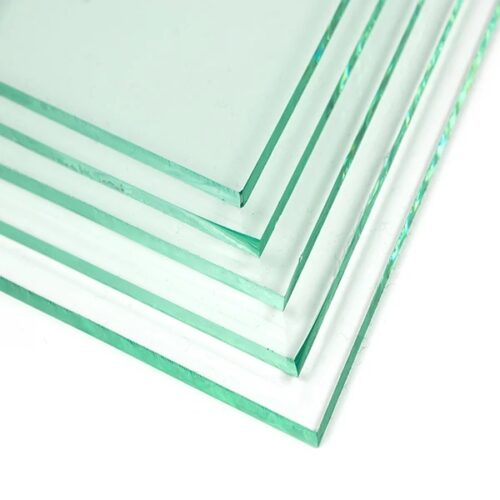
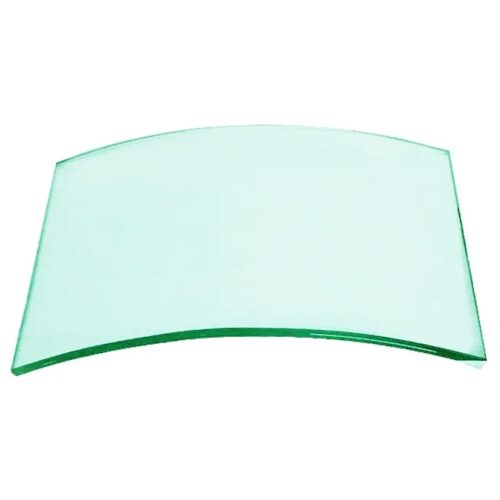
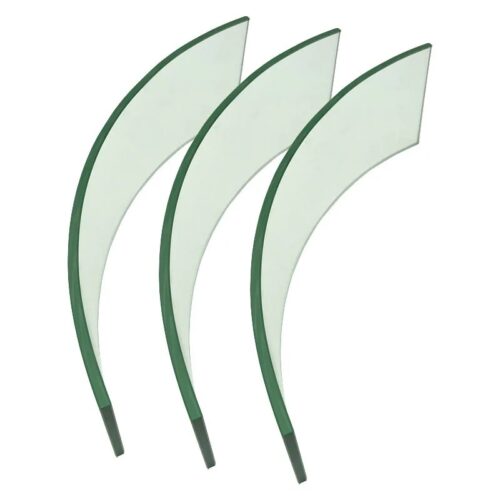
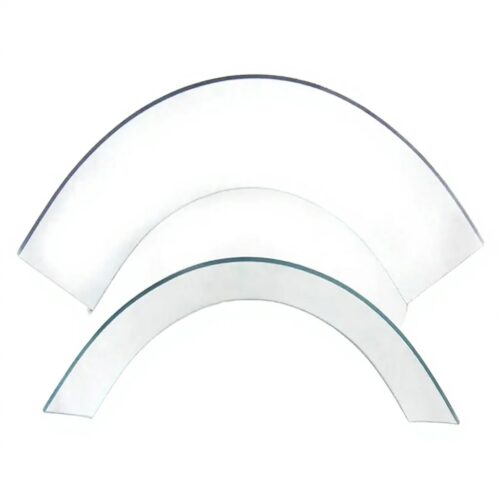
Browse made-to-order curved tempered glass for shower enclosures and other residential applications. Choose custom panel sizes and bend radii, with factory-direct supply and bulk options for lamination.
Production normally begins with float glass cut to the required dimensions, with edge finishing, holes, and cutouts completed before thermal treatment. The manufacturing process involves heating the prepared sheet under controlled conditions. Inside a bending furnace, glass is heated sufficiently to permit deformation; the precise cycle depends on the material and equipment. The softening point is a material reference, not a universal production setting. Shaping the glass requires control of temperature, support, and movement so the intended bend develops without unacceptable surface marking or distortion. For suitable equipment and geometry, the processor forms the sheet and uses an air quench as it is rapidly cooled. This tempering process creates compressive stresses at the surfaces balanced by tensile stresses internally. A mould or adjustable forming system helps establish the profile. Equipment that can bend one product cannot necessarily toughen every other shape, thickness, or finish. Confirm that the proposed curve is achievable in the requested treatment condition. Once treated, a component should not be casually trimmed or drilled to solve a site discrepancy.
How Does Hot Bending Differ from Cold Bending?
Hot forming changes the shape while the material is softened by heat. In gravity bending, a sheet gradually settles onto or into a support and is subsequently cooled under a controlled schedule. This route does not automatically produce a fully tempered product. Some processors bend during a thermal treatment cycle instead. The distinction matters when reviewing a quotation: a price for a shaped component does not establish its treatment condition, and the phrase bent glass alone does not describe the finished assembly or its safety classification. Cold bending creates a curve by mechanically deforming a previously manufactured sheet, typically with framing or another engineered means of retention. The induced stresses consume capacity available for service loads. A separate specialist route forms sheets during bonding so the completed laminate retains its shape. Neither approach can be substituted for hot forming without reviewing the design. Ask how the shape is maintained, what stresses remain, and how these interact with environmental loads. The selected production route should appear in the technical submission.
Does a Curve Increase Strength?
A curve can change how loads travel through a component, but it does not guarantee a higher load capacity. Structural performance depends on geometry, support conditions, material properties, load duration, and imperfections. A cylindrical profile may behave differently from a component curved in two directions. Equally, increasing thickness can affect weight, forming feasibility, and connections. Claims about high strength therefore need a defined basis: what was tested, under which loading arrangement, and how closely does that arrangement resemble the proposed installation? Descriptions such as “up to five times stronger than standard annealed glass” are often used as shorthand for treatment benefits. Such comparisons for flat glass cannot establish a design value for a curved assembly. A promise to combine design with exceptional strength still needs engineering evidence. Curved tempered glass should be assessed for its actual supports and loads, including any required performance after breakage. Ask the engineer which assumptions govern the calculation and which variations would trigger a new review. A different radius, support position, or fixing detail may change the answer.
Which Architectural Applications Benefit from a Curve?
A continuous glass façade can soften a building corner while offering panoramic, unobstructed views. Inside a mall, rounded partitions can guide movement and bring natural light deeper into shared spaces. A skylight introduces different demands, including overhead retention and maintenance access. A balustrade needs appropriate impact resistance, restraint, and performance after breakage. These examples show why safety and aesthetics must be considered together: a visually similar curve can serve very different purposes, and the specification must follow the actual application rather than the photograph that inspired it. For overhead, guarding, or structural uses, selecting a monolithic sheet solely because it is tempered is insufficient. Consider whether the design should laminate multiple plies, how fragments would be retained, and what happens if a component fails. A structural fin also needs a defined load path and connection design. Hurricane resistance requires evidence for the complete tested system, including its frame and attachments. The project team should identify the governing requirements early, then obtain evidence applicable to the proposed construction and jurisdiction.
What Should a Curve Specification Include?
Start with thickness, assembly build-up, height, and width. Define the radius and identify whether it refers to the inner surface, outer surface, or another agreed reference. Include arc length, chord, rise, and bending angle, using consistent units and a clearly oriented drawing. A glass panel described only as “12mm, curved” is not adequately defined. For cylindrical geometry, these dimensions describe related aspects of the same profile; inconsistent values should be resolved before a supplier begins tooling or production. Never leave the controlling dimensions ambiguous. Other proposed shapes need equally clear geometric information and an agreed method of checking them. Digital design files and shared design tools can help architects and designers coordinate the model, but an approved fabrication drawing remains essential. Confirm possible radii, maximum bending limits, and dimensional tolerances for the actual product. Ask which measurements control acceptance and how deviations will be recorded. If adjoining components must meet smoothly, show those interfaces explicitly. A coordinated reference model helps the frame designer, processor, and installer work from the same intended curve.
Which Configuration and Compatibility Checks Matter?
Laminated glass combines sheets with a specified polymer interlayer. Its bonding process, known as lamination, creates a laminate whose behaviour depends on the constituent materials and service conditions. Curved panels can also form part of an insulating unit with spacers, perimeter seals, and a defined cavity. To insulate effectively, the complete assembly needs suitable thermal characteristics and edge detailing. These options can overlap, but their combination must be assessed as a system. A proposed build-up should identify every layer and the role it serves. Coated glass adds further processing constraints. A low-e coating must be suitable for the intended bend, heat treatment, surface position, and adjacent materials. Written confirmation should cover the actual product rather than a broad statement about a supplier’s range. Check seals, interlayers, edge treatments, and any ceramic decoration as applicable. When comparing alternatives, ask whether the proposal preserves the required thermal, solar, acoustic, and retention performance. The ability to customise appearance does not establish that every material combination is technically suitable or supported by testing.
Curved Tempered Glass FAQs
Explore common uses for curved tempered glass, from shower enclosures to architectural features. Learn about custom sizes, bend radii, and laminated options, and find out what drawings and specifications to send for a quote.
What is curved tempered glass used for?
Curved tempered glass is used in shower enclosures, office partitions, reception desks, and retail displays. It can also be specified for architectural features such as curved façade accents.
Can you make curved tempered glass to a custom size and radius?
Yes. We manufacture panels to match your opening or project drawings. We can also polish edges and add holes, notches, or cutouts for hinges, clamps, and other fittings.
Is curved tempered glass available in a laminated option?
Yes. We offer curved laminated glass on request. Share your intended application and glazing specifications so we can review the required glass build-up.
What information do you need to quote curved tempered glass?
Please send the panel dimensions, glass thickness, bend radius, quantity, and intended application. If you have a CAD drawing or template, include it and mark whether the radius is measured on the inside, outside, or centerline of the glass. Note any requirements for edge finishing, holes, or cutouts.